
2025-2026 Annual report
The best time to act: Prevention and early intervention
Preventing cancer before it starts is one of the most powerful ways to reduce its burden on individuals, families and the health system. This year, Canada’s efforts to eliminate cervical cancer gained significant momentum as jurisdictions expanded HPV vaccination and screening initiatives, strengthened implementation planning and worked to reach populations that have historically faced the greatest barriers to care. Together, these efforts reflect a broader shift from strategy development toward large-scale implementation and measurable impact.
On this page:
Eliminating cervical cancer is within reach
Cervical cancer can be eliminated within a generation. Canada is on track to achieve that goal by 2040, but the decisions made now will determine whether elimination remains within reach.
The case for acting urgently is both human and fiscal. HPV-related cancers cost Canada’s health system more than $300 million in 2024 alone. A national progress report released by CPAC in January 2026 is unambiguous:
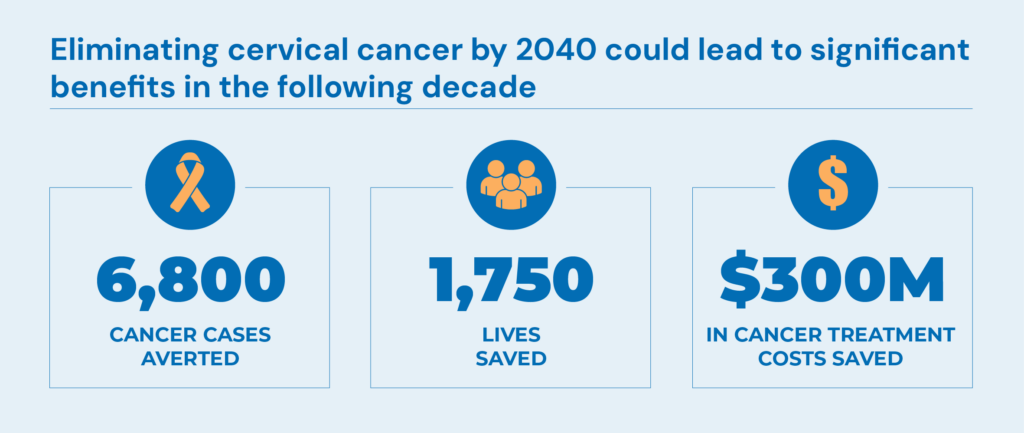
The opportunity is significant — and so is the urgency.
From alignment to action
That urgency is reflected in growing national alignment. As a result of CPAC’s continued leadership, senior public health leaders – including the Chief Public Health Officer of Canada, the Council of Chief Medical Officers of Health and the Canadian Immunization Committee – agreed that there is an urgent need for coordinated implementation of HPV vaccination programs to reach the goal of elimination. Across the country, many jurisdictions are making dedicated progress toward the goals of the Action Plan for the Elimination of Cervical Cancer in Canada.
Canada needs to act now. If we can get vaccination coverage and HPV primary screening up to 90% across Canada, cervical cancer can be eliminated soon.
– Dr. Darren Brenner, Molecular Cancer Epidemiologist, Departments of Oncology and Community Health Sciences, University of Calgary
Progress is taking several forms. With CPAC’s support, 12 jurisdictions are advancing HPV primary screening, while partners across the country are also expanding self-screening, vaccination and targeted outreach to people who have historically been left behind by vaccination programs. Together, these examples demonstrate how elimination is moving from plan to practice:
- Prince Edward Island has achieved more than 80 per cent HPV vaccination coverage with at least one dose among 12-year-olds. PEI was also the first province to offer jurisdiction-wide HPV screening.
- Through the Urban Public Health Network, eight partners across provinces are implementing targeted vaccination strategies for First Nations, Inuit and Métis communities, newcomers and refugees, 2SLGBTQIA+ individuals and other underserved populations.
- Newfoundland and Labrador remains the only province meeting the 90 per cent HPV vaccine target in Canada. Following updated national HPV vaccine guidance, the province moved to a one-dose HPV vaccine schedule this year.
- Nova Scotia moved from a two-dose to a one-dose HPV vaccination schedule this year and remains a leader in HPV vaccination coverage, with 83 per cent of those eligible receiving at least one dose.
- The nonprofit Praxus Health expanded bilingual media campaigns across all provinces and strengthened community-based outreach in Alberta through Community Health Ambassadors. An Alberta HPV vaccine education video reached more than two million people — a result that underscores the value of meeting communities where they are.
- British Columbia’s 10-year cancer action plan commits to eliminating this cancer. This year, BC shifted to a one-dose HPV vaccine schedule and expanded the publicly funded HPV vaccine up to age 26 for most populations, and up to age 45 for immunocompromised, queer and two-spirit populations. It also became the first province to offer province-wide HPV self-screening, enabling people to collect their own samples without needing to see a clinician. Self-screening provides choice for British Columbians on how they participate in cervix screening, reducing barriers and supporting patients to choose the option that works best for them.
- In November 2025, Alberta implemented a phased approach to make HPV screening available across the province for people aged 50–69. Alberta continues to transition to other age groups and explore opportunities for HPV self-screening.
- The Northwest Territories reached a significant milestone this year by implementing updated clinical practice guidelines for cervical cancer screening that support the transition to primary HPV screening, including self-screening. To improve equitable access to screening, the territory is piloting a self-screening HPV mail-out initiative, providing eligible residents in rural and remote communities with a convenient alternative to attending a primary care appointment for cervical cancer screening.
- Planning is also underway to establish a territorial collective for the elimination of cervical cancer, which will support coordinated HPV vaccination and screening efforts across the territories.
The work ahead
Despite this progress, gaps remain. Achieving elimination will require sustained improvements in vaccination and screening uptake across all jurisdictions, with targeted efforts to reach populations facing the greatest barriers.
One of the big challenges in eliminating cervical cancer is reaching women who have traditionally been under-screened and under-vaccinated. Understanding and addressing barriers to access is crucial for screening and immunization programs to better meet the needs of diverse populations and reduce rates of cervical cancer.
– Dr. Gina Ogilvie, Tier 1 Canada Research Chair in Global Control of HPV-related diseases and prevention, University of British Columbia
The path to elimination is clear: the priority now is to ensure consistent and equity-focused implementation across the country. Through contributions to the federal Interim National Immunization Strategy (2025–2030), and ongoing collaboration with national, jurisdictional and international partners, CPAC is supporting a more coordinated, pan-Canadian response.