
2025-2026 Annual report
Advancing reconciliation through First Nations, Inuit and Métis leadership
CPAC’s work with First Nations, Inuit and Métis partners continued to move from planning to implementation this year, with reconciliation increasingly embedded in how cancer system priorities are funded, governed, evaluated and sustained.
As CPAC enters the final year of its 2022–2027 business plan, work remains on track across three interconnected priorities: culturally appropriate care closer to home; Peoples-specific, self-determined care; and First Nations-, Inuit- and Métis-governed research and data systems.
That progress is reflected in the scale and depth of partner-led work now underway. Across all jurisdictions, including at the national level, CPAC has established 60 funding agreements, eight of them new this year. These projects are expected to positively impact more than 750 First Nations, Inuit and Métis communities, organizations and governments.
How CPAC and our partners are carrying out this work is central to its impact. Ninety-five per cent of agreements are led or co-led by First Nations, Inuit or Métis governments, organizations and associations. Collectively, the projects are working with more than 190 First Nations, Inuit and Métis governments, organizations and community partners.
On this page:
- Strengthening culturally appropriate care closer to home
- Advancing Peoples-specific cancer services
- Advancing First Nations-, Inuit- and Métis-governed research and data systems
- Supporting knowledge sharing and sustainability
- Embedding reconciliation across CPAC
Strengthening culturally appropriate care closer to home
Across the country, First Nations, Inuit and Métis partners are advancing models of care that reflect community priorities, cultural safety and local realities.
Cancer Care Alberta has developed respectful and collaborative relationships with First Nations and Métis communities and organizations through the Strengthening Indigenous Cancer Care Together Sharing Circle. Participation by the Otipemisiwak Métis Government, the Metis Settlements General Council, Blackfoot Confederacy, G4 Health, Confederacy of Treaty Six First Nations and Treaty 8 First Nations of Alberta significantly strengthened the circle over the course of the project.
Cancer Care Alberta also introduced practical changes to make the cancer patient experience more culturally safe:
- Distributed 32 smudge kits and developed a micro-learning module to support smudging for cancer patients at six cancer treatment sites.
- Increased staff capacity for Indigenous cancer patient and family supports, adding four staff positions.
- Launched seven new micro-learning modules for frontline staff, focused on getting to know local communities and culturally safer day-to-day care.
- Created a new Indigenous Relationship Preparedness Workbook to help teams assess their readiness to engage in meaningful partnerships with communities.
Together, these changes are helping expand culturally appropriate care throughout the cancer system.
Advancing Peoples-specific cancer services
Peoples-specific approaches are also changing how cancer screening and diagnosis are delivered.
In Quebec, Listuguj Community Health Services and CISSS de la Gaspésie, Santé Québec, co-developed and implemented a Mi’gmaq-led cancer screening and diagnosis model that now serves more than 4,000 community members. The initiative established a dedicated screening desk, strengthened referral pathways and increased access to screening for colorectal, breast, cervical, lung and prostate cancers.
The model is grounded in extensive community engagement and culturally relevant outreach, including radio, video and storytelling rooted in Mi’gmaq oral traditions. These approaches have helped improve awareness and trust in screening services, contributing to increased participation and more timely diagnostic follow-up.
The work has also shifted practice within the health system. By embedding culturally safe approaches within CISSS services and formalizing cross-jurisdictional collaboration between Quebec and Mi’gmaq partners, the project has created a scalable model to expand more equitable, community-driven cancer screening across other Mi’gmaq communities in the Gaspé region.
In the North, CPAC supported a major milestone in Peoples-specific cancer planning. On March 20, 2026, the Government of Yukon, Yukon First Nations Governments, the Council of Yukon First Nations and the Yukon Hospital Corporation launched the Yukon First Nations Cancer Strategy – the territory’s first-ever cancer strategy and the first of its kind to be guided and led by Yukon First Nations.
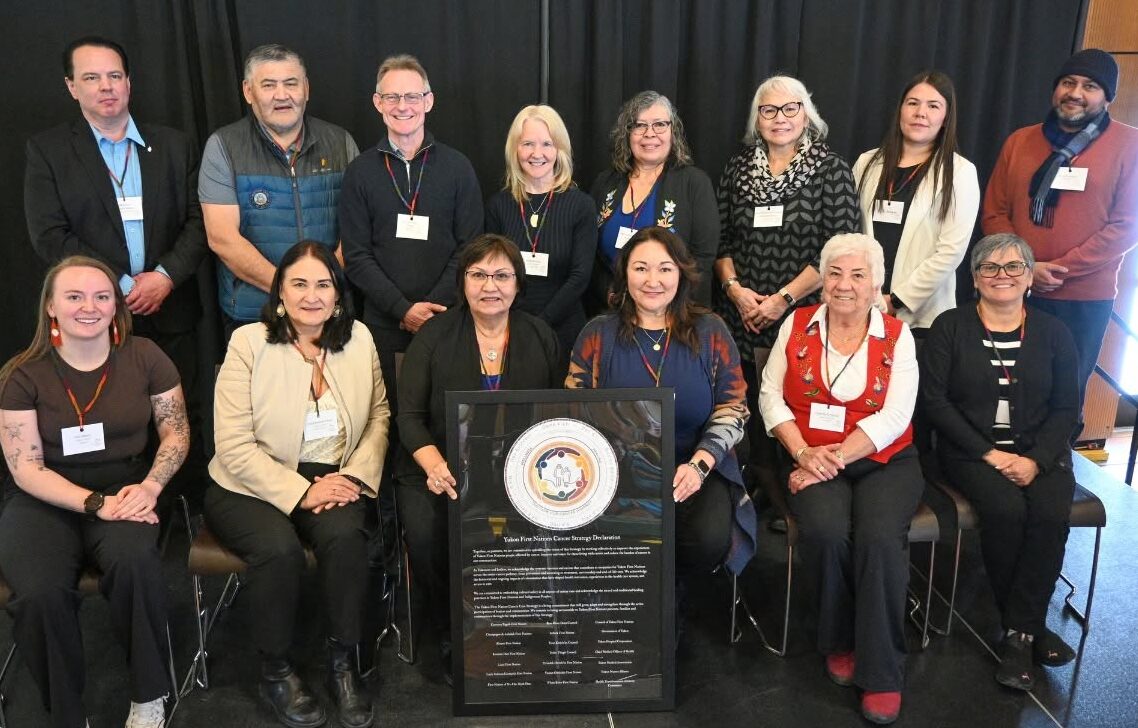
Top row (from left): Hon. Brad Cathers, Minister of Health and Social Services, Government of Yukon; Chief Russell Blackjack, Little Salmon/Carmacks First Nation; Dr. Brendan Hanley, Member of Parliament, Liberal Party of Canada; Pamela Hine, Chair of the Board of Trustees, Yukon Hospital Corporation; Chief Barbara Joe, Champagne and Aishihik First Nations; Chief Elizabeth Bosely, Teslin Tlingit Council; Kyla Magun, Council Member, Liard First Nation; Dr. Sudit Ranade, Chief Medical Officer of Health;
Bottom row (from left): Tia Albers, Board Member, Yukon Nurses Alliance; Chief Pauline Frost, Vuntut Gwitchin First Nation; Doris Bill, Member of Health Transformation Advisory Committee; Grand Chief Math’ieya Alatini, Council of Yukon First Nations; Chief Ruth Massie, Ta’an Kwäch’än Council; Deputy Chief Erin McQuiag, Tr’ondëk Hwëch’in First Nation.
Photo credit: Government of Yukon
Co-developed over several years through the Yukon First Nations Cancer Care Project, with CPAC support since 2018, the strategy sets a shared vision for improving cancer care while embedding Yukon First Nations’ perspectives and priorities in health system planning and delivery. It emphasizes care closer to home, with a strong focus on prevention, screening and patient navigation.
While centred on the needs of Yukon First Nations, many of the actions in the strategy are expected to improve cancer experiences and outcomes for all people in the Yukon.
Advancing First Nations-, Inuit- and Métis-governed research and data systems
First Nations-, Inuit- and Métis-governed research and data systems remained a major focus this year, reflecting the importance of self-determination in how data are collected, governed, interpreted and used.
In March 2026, CPAC convened the inaugural First Nations, Inuit and Métis Data and Data Governance Steering Committee. The committee will co-create an approach to identifying Peoples-specific, self-determined priorities and developing system-level indicators to inform efforts to close health-equity gaps.
CPAC also convened a Community of Practice for First Nations, Inuit and Métis-Governed Research and Data Systems, bringing together 36 participants from 15 funded partners across 11 jurisdictions. The session focused on Inuit-specific, self-determined research priorities, including lessons from the Qanuinngitsiarutiksait research program, Inuit-led and Inuit-governed research methods, and the importance of elevating Inuit voices in health data, governance and service delivery.
These efforts are helping strengthen the foundations for cancer data and research systems that are not only more responsive, but more accountable to First Nations, Inuit and Métis priorities, governance and ways of knowing.
Supporting knowledge sharing and sustainability
As partner-led projects mature, CPAC is also supporting opportunities for partners to share learning, build connections and plan for sustainability.
In September 2025, CPAC convened a First Nations, Inuit and Métis funded initiative knowledge translation and exchange meeting, bringing together 57 representatives from 35 funded partner organizations. The meeting focused on sustainability and created space for partners to share strategies for scaling and sustaining initiatives in support of long-term goals.
Other knowledge exchange activities supported Peoples-specific priorities across the cancer continuum. A virtual Colorectal Cancer Screening Territorial Collective brought together territorial partners and expert advisors to share updates, promising practices and lessons learned related to screening for people living in the territories. A separate knowledge translation and exchange meeting connected partners from seven funded palliative care projects to share approaches to palliative care training in community.
CPAC supported the First Nations, Inuit and Métis stream of the 2025 Canadian Cancer Research Conference. This included launching the two inaugural First Nations, Inuit and Métis cancer research awards, four dedicated concurrent sessions, the hosting of First Nations, Inuit and Métis Elders and the showcasing of First Nations, Inuit and Métis knowledge products. Presentations on CPAC’s approach to advancing self-determined Indigenous priorities through relationships with First Nations, Inuit and Métis partners and how we take a culturally grounded and Peoples-specific approach to nurture relationships on common ground were warmly received at the 2026 World Indigenous Cancer Conference.
Embedding reconciliation across CPAC
CPAC’s reconciliation work also continued through strategic partner relationships and internally. Through the First Nations, Inuit and Métis Strategic Engagement Plan, CPAC held 14 meetings with leaders of First Nations, Inuit and Métis organizations to identify opportunities to advance shared priorities.
In May 2026, CPAC formalized its longstanding relationship with the Métis National Council through a signed relationship agreement, which describes how the organizations will interact and support common interests. The signing built on collaboration dating back to 2007 to drive systemic change and close gaps in cancer care with Métis patients and communities. It marks CPAC’s second relationship agreement with a partner following its 2022 agreement with the First Nations Health Managers Association.
All CPAC teams have implemented reconciliation workplans and will continue to advance them. Staff are using the Awareness to Action toolkit, developed by the Indigenous Reconciliation Group, to translate reconciliation commitments into team-level accountabilities. CPAC also continued to build staff and Board capacity through training on Indigenous cultural competence and humility, First Nations Principles of OCAP® (Ownership, Control, Access and Possession) and other learning opportunities related to First Nations, Inuit and Métis data governance.
A partner consent strategy has also been developed to support First Nations, Inuit and Métis data governance principles and consent. This is especially important as CPAC continues to evaluate and communicate the impact of partner-led work in ways that respect Indigenous data sovereignty.