
Lung cancer screening progress in Canada
Impact of lung cancer screening in Canada
Screening is helping more people get diagnosed at an earlier stage, improving outcomes and reducing deaths from lung cancer. Through national collaboration and investment, the Partnership and its partners are strengthening screening models of care across Canada.
Key takeaways
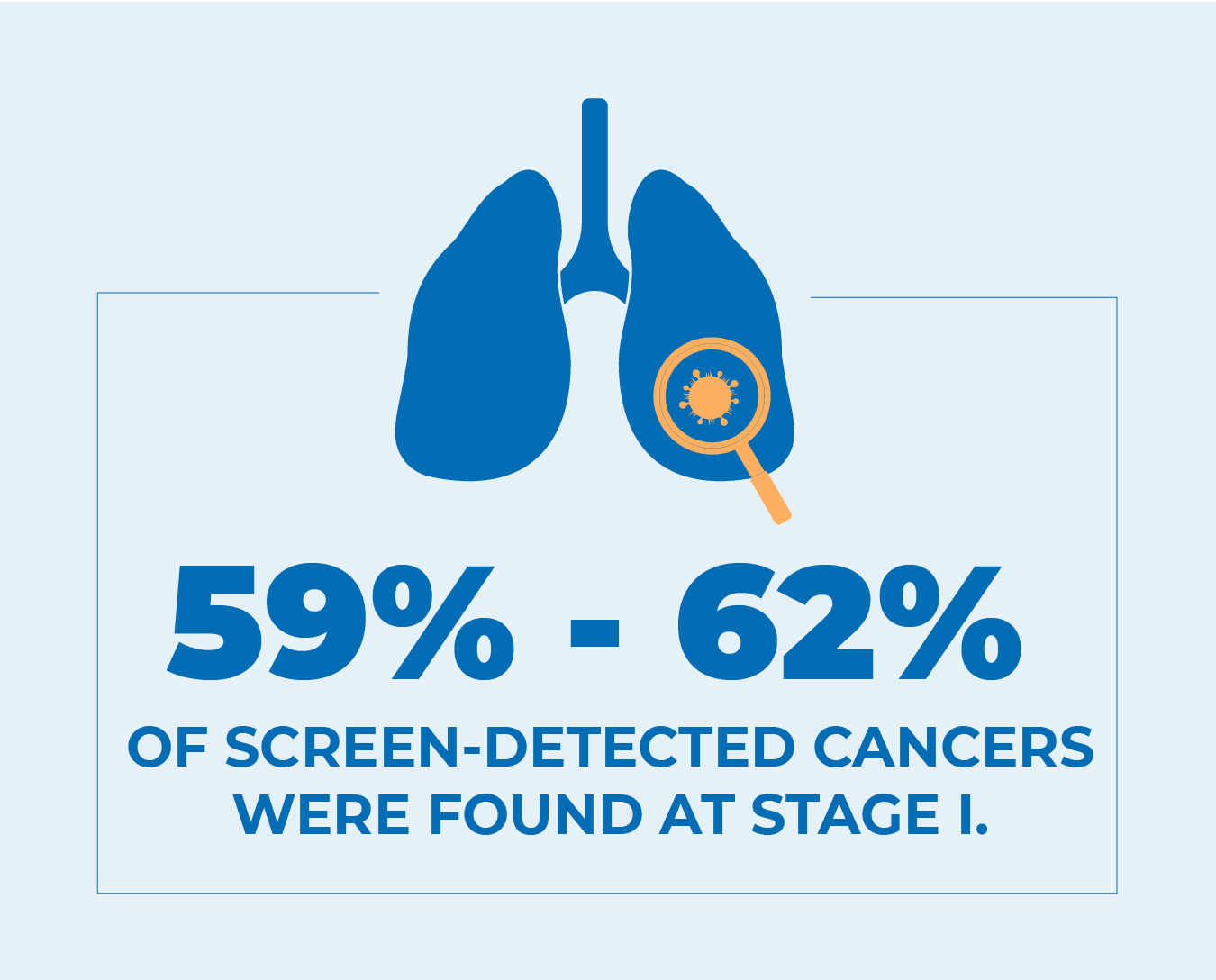
- Screening is improving outcomes through earlier stage detection. (1-3) About 60 per cent of screen-detected lung cancers are stage I, before disease becomes advanced and when treatment has the greatest potential to improve outcomes. (2-3)
- Engagements with individuals from communities experiencing inequities are informing more responsive screening models that reach and support those at highest risk for developing lung cancer. (4-5)
- Engagements with First Nations, Inuit and Métis are shaping culturally appropriate screening models. (4)
Impacting the health system and health outcomes
Quality screening indicators in Canada provide early insight into the effect lung cancer screening is having on specific populations.
Participation
- This early data shows participation by eligible individuals in a routine low-dose computed tomography (LDCT) scan after risk assessment ranges from 75 per cent to 88 per cent.
Percentage of screen-eligible individuals aged 50-74 who completed a routine LDCT scan within 6 months after risk assessment, by jurisdiction
These graphs display only data available at the time of data collection.
Program parameters and measurement time frames differ across jurisdictions. As such, direct comparisons across jurisdictions may not be appropriate and should be interpreted with caution.
BC: The eligible individuals were aged 55-74 at triage and had a 1.5 per cent or greater risk of developing lung cancer. Data included some individuals aged 50-54, who were assessed on referrals before their 55th birthday.
ON: The eligible individuals were current or former smokers, aged 55-74 at triage, and had a 2 per cent or greater risk of developing lung cancer.
QC: The eligible individuals were current or former smokers who have smoked for more than 20 years, aged 55-74 at triage and had a 2 per cent or greater risk of developing lung cancer. The data were from June 2023 to May 2024, which included some individuals aged 50-54.
AB: The eligible individuals were aged 50-74 and had a 1.5 per cent or greater risk over six years of developing lung cancer.
Data source: Provincial cancer agencies and pilot projects.
Detection rate
- The detection rate (per 1,000 screen-eligible individuals) of invasive lung cancer ranges from five to 14 cancers and is higher in females, which aligns with higher incidence rates in females that have been observed in recent years.
Detection rate (per 1,000) of invasive lung cancers within 6 months of routine LDCT scans among screen-eligible individuals aged 50-74, by jurisdiction |
Detection rate (per 1,000) of invasive lung cancers within 6 months of routine LDCT scans among screen-eligible individuals aged 50-74, by jurisdiction and sex |
This graph displays only data available at the time of data collection.
Program parameters and measurement time frames differ across jurisdictions. As such, direct comparisons across jurisdictions may not be appropriate and should be interpreted with caution.
AB: Data suppressed due to small counts.
Data source: Provincial cancer agencies and pilot projects.
Cancer stage distribution
- Early detection is significant. Finding more cancers at an earlier stage is an important outcome. Early detection improves the chances of successful treatment and survival, enhances quality of life, and can reduce the complexity and cost of care.(6-8)
- About 60 per cent of lung cancers found through routine LDCT screening are diagnosed at stage I, when the cancer is at an early stage, and, only about 10 per cent are diagnosed at more advanced stage IV. Lung cancer screening does not improve survival within a stage; its benefit comes from finding cancer earlier, before it progresses.
- Finding more early-stage cancers among people who qualify for screening suggests the lung cancer screening programs are achieving their intended purpose and identifying a greater proportion of lung cancers in screening participants before the cancer becomes advanced. Unlike breast, colorectal and cervical screening which target broad population groups, lung cancer screening is limited to people who have a higher risk of developing lung cancer.
Distribution of invasive lung cancer stage at diagnosis, BC (2023) and ON (2020) combined
This graph displays only data available at the time of data collection.
Cancer registry data come from the BC Cancer Registry and the Ontario Cancer Registry. Screen-detected data come from the indicator results presented in the Monitoring and evaluation of lung cancer screening quality indicators, 2022-2024 report. British Columbia data is from 2023 and Ontario’s data is from 2020.
Unknown and unstaged cases are excluded from analysis; the proportion of these cases were approximately 5 per cent from all screen-detected cases.
Percentages may not add up to 100 per cent due to rounding.
The data sources represent different populations. Cancer registry data for stage include all lung cancer cases diagnosed among individuals aged 18 years and older (including screen-detected cancers), while screen-detected data include only cancers diagnosed among participants eligible for their jurisdiction’s lung cancer screening program.
Outcomes demonstrate the value of lung cancer screening
These early signals suggest lung cancer screening is beginning to positively influence patient outcomes and health system performance, while providing data to support program effectiveness and sustainability as screening continues to expand across Canada. However, gaps exist in the collection and reporting of equity data. Strengthening data systems will be critical to monitoring participation and outcomes among populations experiencing inequities and ensuring lung screening benefits all people in Canada.(9-10)
- Wilkinson AN, Lam S. Lung cancer screening primer: Key information for primary care providers. Can Fam Physician. 2021 Nov;67(11):817-822. doi:10.46747/cfp.6711817. Available from: https://www.cfp.ca/content/cfp/67/11/817.full.pdf
- Ellison LF, Saint-Jacques N. Five-year cancer survival by stage at diagnosis in Canada. Health Rep [Internet]. 2023 Jan ;34(1):3-15 [cited 2026 Aug 10]. Available from: https://www150.statcan.gc.ca/n1/pub/82-003-x/2023001/article/00001-eng.htm . doi:10.25318/82-003-x202300100001-eng
- Canadian Cancer Statistics Advisory Committee, in collaboration with the Canadian Cancer Society, Statistics Canada, and the Public Health Agency of Canada. Canadian Cancer Statistics 2025 [Internet]. Toronto (ON): Canadian Cancer Society; 2025 [cited 2026 Aug 10]. Available from: https://cancer.ca/en/cancer-information/resources/publications/canadian-cancer-statistics-2025
- Canadian Partnership Against Cancer. Lung cancer screening in Canada, 2026: Summary [Internet]. Toronto (ON): Canadian Partnership Against Cancer; 2026 [cited 2026 Aug 10]. Available from: https://www.partnershipagainstcancer.ca/topics/lung-cancer-screening-canada/summary/
- Canadian Partnership Against Cancer. Expanding lung cancer screening [Internet]. Toronto (ON): Canadian Partnership Against Cancer; 2025 [cited 2026 Aug 10]. Available from: https://www.partnershipagainstcancer.ca/annual-report/2024-2025-annual-report/year-in-review/early-accurate-diagnosis/expanding-lung-cancer-screening
- Canadian Cancer Statistics Advisory Committee, in collaboration with the Canadian Cancer Society, Statistics Canada, and the Public Health Agency of Canada. Canadian Cancer Statistics: A 2024 special report on the economic impact of cancer in Canada [Internet]. Toronto (ON): Canadian Cancer Society; 2024 December [cited 2026 Aug 7]. Available from: https://cancer.ca/en/cancer-information/resources/publications/canadian-cancer-statistics-a-2024-special-report-on-the-economic-impact-of-cancer-in-canada
- Ellison LF, Saint-Jacques N. Five-year cancer survival by stage at diagnosis in Canada. Health Rep [Internet]. 2023 Jan ;34(1):3-15 [cited 2026 Aug 10]. Available from: https://www150.statcan.gc.ca/n1/pub/82-003-x/2023001/article/00001-eng.htm . doi:10.25318/82-003-x202300100001-eng
- Canadian Cancer Statistics Advisory Committee, in collaboration with the Canadian Cancer Society, Statistics Canada, and the Public Health Agency of Canada. Canadian Cancer Statistics 2025 [Internet]. Toronto (ON): Canadian Cancer Society; 2025 [cited 2026 Aug 10]. Available from: https://cancer.ca/en/cancer-information/resources/publications/canadian-cancer-statistics-2025
- Canadian Partnership Against Cancer. Pan-Canadian Cancer Data Strategy [Internet]. Toronto (ON): Canadian Partnership Against Cancer; 2024 [cited 2026 Aug 10]. Available from: https://www.partnershipagainstcancer.ca/about-us/corporate-resources-publications/pan-canadian-cancer-data-strategy/
- Ezeife DA, Padmore G, Vaska M, Truong TH. Ensuring equitable access to cancer care for Black patients in Canada. CMAJ. 2022 Oct ;194(41):E1416-E1419. doi:10.1503/cmaj.212076.