
The Continuity of Care Initiative (2014–2017)
Launched in 2014, the Continuity of Care Initiative focused on improving culturally safe care for First Nations, Inuit and Métis patients, particularly those living in rural, remote and isolated communities. Ten multi-jurisdiction, multi-year projects across Yukon, Northwest Territories, British Columbia, Alberta, Saskatchewan, Manitoba, Ontario, Quebec, New Brunswick and Newfoundland and Labrador aimed to strengthen care during diagnosis and at key transitions, such as returning home from urban treatment centres.
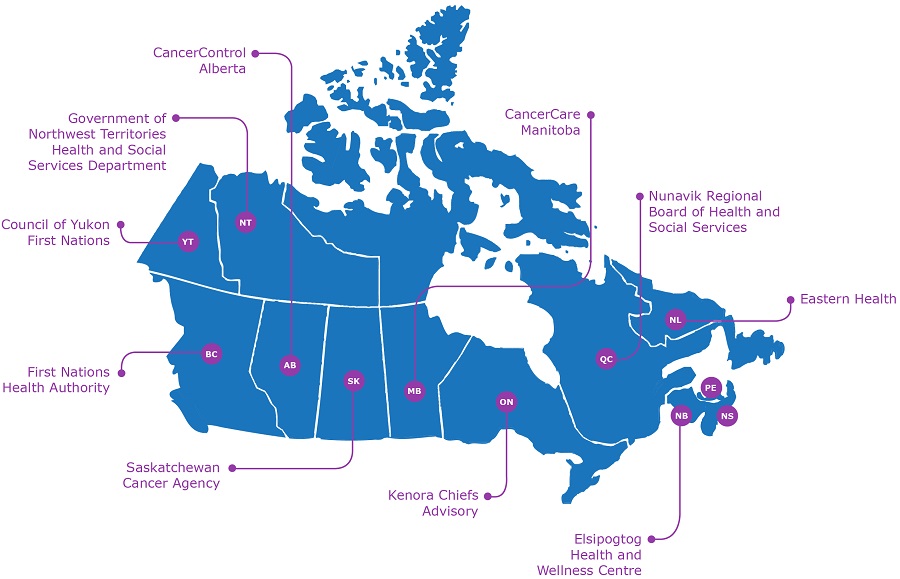
Learn about these 2014-2017 funded projects:
Walk a Mile in My Moccasins – Advancing the First Nations and Métis Cancer Journey in the Yukon aimed to advance education and training for First Nations patients, as well as health care providers. In addition, the initiative focused on the development of a patient identification strategy.
Territory: Yukon
Timeline: 2014-2017
Funded partner: Council of Yukon First Nations (CYFN)
Partners:
- Yukon College
- Yukon Government
- Yukon Hospital Corporation
- Saint Elizabeth First Nations, Inuit and Métis Program
- Teslin Tlingit Council
- Selkirk First Nation
- Vuntut Gwitchin
- Tr’ondek Hwech’in
- Na-cho Nyak Dun
- Little Salmon First Nation
- Kluane First Nation
- Kwanlin Dun
- Champagne and Aishihik
- White River First Nation
- Liard First Nation
- Ross River Dena Council
- Carcross Tagish First Nation
- Ta’an Kwach’an Council
Focus:
- A resource needs workshop was held in July 2014 with Saint Elizabeth First Nations, Inuit and Métis Program to understand the priorities and concerns of First Nations cancer survivors and patients.
- CYFN partnered with Yukon College to create an online course called, Yukon First Nations 101, to provide knowledge of the history of Yukon First Nations agreements, self-government, languages, and basic protocols for working with Yukon First Nations.
- CYFN created a cancer workbook, Following My Path with Cancer, to provide information about navigating the cancer system in the Yukon.
- CYFN worked with the Yukon Government to explore access to Yukon First Nation cancer data by linking the Vital Statistics Registry to the BC Cancer Registry.
- Meetings were also held with First Nation communities to discuss screening practices in their communities and cancer control priorities.
Outcomes:
- Local cancer control priorities were identified and discussed at a CYFN cancer conference with representatives from all 14 Yukon First Nations.
- Following My Path with Cancer is available to First Nations patients across Yukon.
Believe in Our Healing Journey: Supporting Continuity of Care for First Nations, Inuit and Métis Cancer Patients in the Northwest Territories – The Care Project aimed to enhance capacity of the health system to meet the needs of Indigenous cancer patients and their families in a culturally safe and supportive manner, to improve understanding and ease of navigating the continuum of cancer care among Indigenous cancer patients and their families, and to increase telehealth uptake by Indigenous cancer patients in the Northwest Territories.
Territory: Northwest Territories
Timeline: 2014 –2017
Funded partner: Government of Northwest Territories Health and Social Services Department
Partners:
- Akaitcho First Nations
- Dehcho First Nations
- Inuvialuit Regional Corporation
- Gwich’in Tribal Council
- Tłı̨chǫ Government
- Dene Nation
- Northwest Territory Métis Nation
- Stanton Elders’ Council (no longer operating)
- Northern Health Services Network
- Cross Cancer Institute
- Cancer Control Alberta
- Alberta Health Services Communications Division (Provincial Programs)
- NWT Breast Health/Breast Cancer Action Group
- Community health representatives and wellness workers
- Stanton Territorial Hospital
Focus:
Activities were implemented in three priority areas: collaborating with communities, relationship building, and resource development.
- A community-to-community exchange model was established to create opportunities for community members to meet face-to-face to learn from initiatives in each community.
- Open and ongoing dialogue between individuals and organizations in Alberta was established to better connect organizations with the Northwest Territories system and NWT patients.
- A number of person and community-centered resources were produced, presenting information specifically tailored to NWT patients. These resources include: the Community Action Toolkit, the Continuity of Care Video Series; the Sahtu Glossary: Cancer Terminology.
Outcomes:
- Creation of NWT-specific cancer resources
- Strengthened relationships with local providers and communities
- Community-to-community exchange model established
Advancing Improvements in Continuity of Cancer Care for First Nations, Métis and Inuit Patients in Rural and Remote Communities focused on building capacity amongst key First Nations, Métis and cancer care organizations, developing relationships, and enhancing knowledge about the diverse cancer journeys of First Nations and Métis peoples.
Province: British Columbia
Timeline: 2014-2017
Funded partner: First Nations Health Authority (FNHA)
Partners:
- BC Association of Aboriginal Friendship Centres (BCAAFC)
- BC Cancer
- Métis Nation British Columbia (MNBC)
- Provincial Health Services Authority – Indigenous Health Programs (BC)
Focus:
- Community engagement events were hosted for patients, families and healthcare providers to engage in dialogue, and provide input into the initiative.
- A surveillance research project was conducted using data linking the First Nations Health Authority Client File with the BC Cancer Registry to understand incidence and survival rates for common cancers.
- Lunch-n-learn sessions were hosted by BC Cancer, for staff at each of the six regional cancer centres, to promote existing cultural safety and humility training.
- First Nations and Métis art was installed in each of the six BC Cancer centres to create a culturally reflective space and to facilitate the building of regional and provincial relationships.
- First Nations and Métis-specific patient navigation support books were developed and disseminated to provide information on local services, gathering support, and navigating the cancer journey.
Outcomes:
- FNHA, along with Métis Nation British Columbia and the BC Cancer committed to developing a joint provincial Indigenous cancer strategy
Increased Access to Culturally Safe Cancer Care Pathways by Alberta First Nations in Rural Remote and Isolated Communities aimed to improve the cancer pathway for First Nations in Alberta and was inclusive of diagnosis, treatment and discharge or a return to primary‐based care. The objective was to develop and implement a strategy for increased access to cancer care by Alberta First Nations in rural, remote and isolated communities.
Province: Alberta
Timeline: 2014-2017
Funded partner: Alberta Health Services – CancerControl Alberta
Partners:
- Alberta First Nations Information Governance Centre
- Confederacy of Treaty Six First Nations
- Canadian Indigenous Nurses Association
- Health Canada, First Nations Inuit Health Branch
- Indigenous Physicians Association of Canada
- Treaty 8 First Nations of Alberta
- Treaty 7 Management Corporation
- University of Alberta
- University of Calgary
Focus:
- A needs assessment of First Nation cancer experiences was carried out using focus groups with the intent to identify priorities to increase access to culturally responsive cancer care and improve multi-jurisdictional support of First Nations cancer patients and families along the cancer pathway.
- A feasibility assessment to understand the needs and requirements for collection of First Nations cancer data was also conducted.
- A determinants of health and community-driven approach in conjunction with Indigenous research methodologies was used to guide the work undertaken in this initiative.
Outcomes:
- The Alberta Baseline Assessment Report, describing the cancer care experiences of First Nations in Alberta.
- Created a framework for the development and use of First Nation identifiers in cancer care
First Nations and Métis Cancer Surveillance Program aimed to (1) develop the capacity for surveillance of cancer among Status First Nations, and (2) work with the community regarding cancer control including community-identified gaps in programs and services, and cancer prevention and early detection priorities.
Province: Saskatchewan
Timeline: 2014-2017
Funded partner: Saskatchewan Cancer Agency
Partners:
- Federation of Sovereign Indigenous Nations
- Ochapowace First Nation
- English River First Nation
- Battle River Treaty 6 Health Centre
- Eagle Moon Health Office
- First Nations and Inuit Health Branch in SK
- Northern Inter-Tribal Health Authority
- Île-à-la-Crosse
- Pinehouse
Focus:
- Battle River Treaty 6 Health Centre created community profiles for each of the communities they serve to provide information on health services available, contact information, hours/days of availability of various services, and other information relevant to care teams coordinating patient transitions in and out of the community during treatment.
- English River First Nation created patient videos that can be used as a resource for Dene-speaking northern patients and families.
- Cancer awareness activities including health fairs and lunch-and-learns related to early detection were held in each of the five partnering communities.
- An application to Indigenous and Northern Affairs Canada was submitted to access the Indian Registration System for linkage with Saskatchewan Cancer Agency databases to develop the capacity for cancer surveillance.
Outcomes:
- Increased knowledge of First Nations and Métis cancer experiences
- Increased awareness of existing culturally relevant supports and services
- Improved patient transitions in care
Improving the Continuity of First Nations and Inuit Cancer Care in Manitoba aimed to improve transitions between cancer care and primary care by enhancing communication between these systems, improving existing practices used to deliver cancer diagnosis to patients and families; and supporting the development of a strategic plan for self-identification in Manitoba.
Province: Manitoba
Timeline: 2014-2017
Funded partner: CancerCare Manitoba
Partners:
- Assembly of Manitoba Chiefs
- Cree National Tribal Health
- Dakota Ojibway Tribal Health
- First Nations, Inuit Health Branch
- First Nations and Metis Health
- Interlake-Eastern Regional Health Authority
- Northern Regional Health Authority
- Northlands Denesuline First Nation
- Sagkeeng First Nation
- Southern Chiefs Organization
- Winnipeg Regional Health Authority
- Saint Elizabeth, First Nations, Inuit and Metis Program
- Keewatin Tribal Health
- Manitoba Keewatinowi Okimakanak
Focus:
- CancerCare Manitoba’s Moving Forward After Cancer transition tools were adapted to ensure cultural safety and equal access for First Nations and Inuit patients.
- Culturally responsive diagnosis delivery guidelines were developed and disseminated to improve practices aimed at delivering cancer diagnoses to patients and families.
- A culturally responsive cancer Diagnosis Support Tool for patients for use by health care providers in a diagnosis delivery context was also created and incorporated into the training of health care providers to reduce patient and family stress after receiving a cancer diagnosis.
Outcomes:
- Resources and tools were developed and implemented to promote culturally responsive and safe care delivery (Patient Pathways, First Nations Patient Guide and Patient Story Video – Diagnosis Delivery).
First Nation Data Linkage – Kenora Chiefs Advisory aimed to address the health information gap associated with the lack of cancer-related data specific to First Nations. The objective was to present information on the quality and feasibility of a potential community cancer profile report using data from (i) a linkage between Kenora Chiefs Advisory First Nations Client Registry and Cancer Care Ontario’s Ontario Cancer Registry and InScreen (Cancer Care Ontario’s cancer screening data hub), and (ii) investigation of postal codes associated with Kenora Chiefs Advisory communities.
Province: Ontario
Timeline: 2016-2017
Funded partner: Kenora Chiefs Advisory
Partner: Cancer Care Ontario
Focus:
- To measure cancer burden, the Kenora Chiefs Advisory First Nations Client Registry was probabilistically linked to a subset of the Ontario Cancer Registry consisting of cancers diagnosed between 1991 and 2013, and preliminary cancers diagnosed in 2014.
- A list of postal codes was submitted by Kenora Chiefs Advisory to explore the development of a cancer profile using postal code geography.
- Community cancer screening data were analyzed using a deterministic linkage approach for the linkage of the Kenora Chiefs Advisory First Nations Client Registry to InScreen.
Outcomes
- The Kenora Chiefs Advisory First Nations Client Registry was successfully linked with Cancer Care Ontario’s Ontario Cancer Registry and InScreen
- Screening activity reports were developed from data linkage between the Kenora Chiefs Advisory First Nations Client Registry and InScreen
- Key lessons from this initiative were identified to improve ongoing linking of the Kenora Chiefs Advisory First Nations Client Registry with Cancer Care Ontario’s Ontario Cancer Registry and InScreen
Culturally Adapted, Quality Care and Services for Inuit and Cree Patients with Cancer from Northern Québec aimed to improve the quality and cultural relevance of health care and health services for First Nations and Inuit patients with cancer.
Province: Quebec
Timeline: 2014-2017
Funded partner: Nunavik Regional Board of Health and Social Services
Partners:
- Cree Board of Health and Social Services of James Bay
- Nunavik Coordination and Advisory Committee Against Cancer
- Inuulitsivik Health Centre
- Ungava Tulattavik Health Centre
Focus:
- Region-specific booklets were developed providing information about local services, tools to prompt discussion and reflection, and knowledge to aid in decision-making about care to guide patients and families through the cancer journey.
- A cultural competency training program was further enhanced to provide context to health care providers living and working in rural and remote communities in Nunavik.
- A preliminary cancer control strategy for the Inuit population of Nunavik, Region 17, Quebec was developed in collaboration with Nunavik Coordination and Advisory Committee Against Cancer focusing on the following priorities: early intervention in the development of cancer, accessibility of care and services, quality of care and services, and network functioning.
Outcomes:
- Development of a cancer strategy in Nunavik, Region 17, Quebec
Improving the Journey for Elsipogtog First Nation Patients Along the Cancer Care Continuum aimed to improve the journey of Elsipogtog First Nations patients along the cancer care continuum by identifying client needs, creating solutions to improve quality patient-centered navigation and discharge planning, generating ways to provide culturally responsive care, and by developing and implementing a community-based physical activity and cancer survivorship program.
Province: New Brunswick
Timeline: 2016-2017
Funded partner: Elsipogtog Health and Wellness Centre
Partners:
- Elsipogtog traditional elders and cancer survivors
- Dr. Georges-L.-Dumont University Hospital Centre (Vitalité Health Network)
- The Moncton Hospital (Horizon Health Network)
- New Brunswick Health Council
- New Brunswick Breast & Women’s Cancer Partnership
- New Brunswick Department of Health (New Brunswick Cancer Network)
Focus:
- A steering committee was formed to provide advisory support and guide project work.
- Patient survivor stories and results from the New Brunswick Hospital Patient Care Experience Survey (NBHC, 2013), New Brunswickers’ Experiences with Primary Health Services (NBHC, 2014) and New Brunswickers’ Experiences with Home Care (NBHC, 2015) were documented, analyzed and compared to understand First Nation cancer experiences.
- A cultural sensitivity training session was organized for oncology staff at Vitalité Health Network and Horizon Health Network in January 2017 to increase knowledge and awareness of First Nation cultures and worldviews to promote culturally safe cancer care delivery.
Outcomes:
- Strengthened relationships and knowledge exchange between project partners
- Community-based physical activity and cancer survivorship programs were developed and implemented by Elsipogtog Health and Wellness Centre
A Journey in the Big Land: Enhancing Cancer Care Services for First Nations, Inuit and Métis in Labrador aimed to enhance transitions in care between hospital and community settings, expand the tele-oncology model for improved access to care, and increase cultural safety in the delivery of health services.
Province: Newfoundland and Labrador
Timeline: 2014-2017
Funded partner: Eastern Health
Partners:
- Nunatsiavut Government Department of Health and Social Development
- Mushuau Innu First Nation
- Sheshatshiu Innu First Nation
- Nunatukavut Community Council
- Labrador‐Grenfell Health
- Dr. H. Bliss Murphy Cancer Care Foundation
- Canadian Cancer Society
- Cancer patients/survivors/caregivers/family and community members
Focus:
- Community and clinic profiles were developed in partnership with First Nations and Inuit partners, Labrador-Grenfell Health and Eastern Health to facilitate discharge planning for patients returning to their home communities from secondary or tertiary level care.
- An orientation video tour of the Cancer Centre in St. John’s and the hospital in Happy Valley‐Goose Bay was developed as a resource for patients.
- A cultural safety-training program developed by the Government of Newfoundland and Labrador Department of Health and Community Services was delivered to health care professionals.
Outcomes:
- Innovative tools and resources were developed to ensure delivery of culturally safe care to improve health outcomes for First Nations, Inuit and Métis peoples living in Labrador