Breast cancer screening in Canada, 2026
About this environmental scan and the status of breast cancer screening
This environmental scan summarizes the data provided by provincial and territorial screening programs and is intended to inform provincial and territorial decision-making for policy and practice. A significant refresh of the E-Scan took place in 2023-2024. The content of this E-Scan is based on data from the 2023-2024 E-Scan with updates in 2026 that reflect significant updates to breast cancer screening programs and changes identified by jurisdictional partners. Data collection dates vary and are listed on each page.
Breast cancer screening programs in Canada are continuously evolving. For more current information, please reference each jurisdiction’s program website.
Breast cancer screening programs
 Organized cancer screening programs are characterized by essential elements, including eligibility criteria, quality assurance mechanisms, pathways to diagnostic follow-up, and participant recall. Due to the focus on quality assurance and equitable access, organized screening programs are able to better balance the potential benefits and harms of screening for participants.
Opportunistic screening generally occurs outside of organized cancer screening programs and does not encompass all of the essential elements that characterize organized screening. Approaches to cancer screening in Canada includes both organized screening programs and opportunistic screening with some jurisdictions offering a model that encompasses elements of both.
Across Canada, cancer screening is available in every province and territory, although there are differences in the approaches used. While fully organized programs are encouraged and supported by existing research (WHO, IARC), programs do not need all elements of an organized screening program to provide access to screening for their population .
Two key frameworks that outline elements of organized cancer screening programs are referenced throughout the e-scans:
- International Agency for Research on Cancer (IARC): An international consensus on the essential and desirable criteria for an ‘organized’ cancer screening programme.
- World Health Organization (WHO): Screening programmes: a short guide. Increase effectiveness, maximize benefits and minimize harm.
The E-Scans will highlight elements of Canadian screening programs that align with these frameworks, as well as explore elements that are unique to the pan-Canadian context.
Learn more about breast cancer screening in Canada:
Alignment with Canadian Strategy for Cancer Control, 2019-2029
The Canadian Strategy for Cancer Control (the Strategy) calls for the continued focus on existing screening programs, such as continuing measures to ensure the right people are getting screened at the right times and eliminating barriers to participation in screening. This particularly applies to equity-denied communities that experience barriers to access. The Strategy also calls for the adoption of innovations and enablers that allow cancer care to be provided closer to home and in a culturally sensitive manner.
This environmental scan reflects Priority 2, Action 2, and Priority 4, Action 1 and Action 2, of the Strategy.
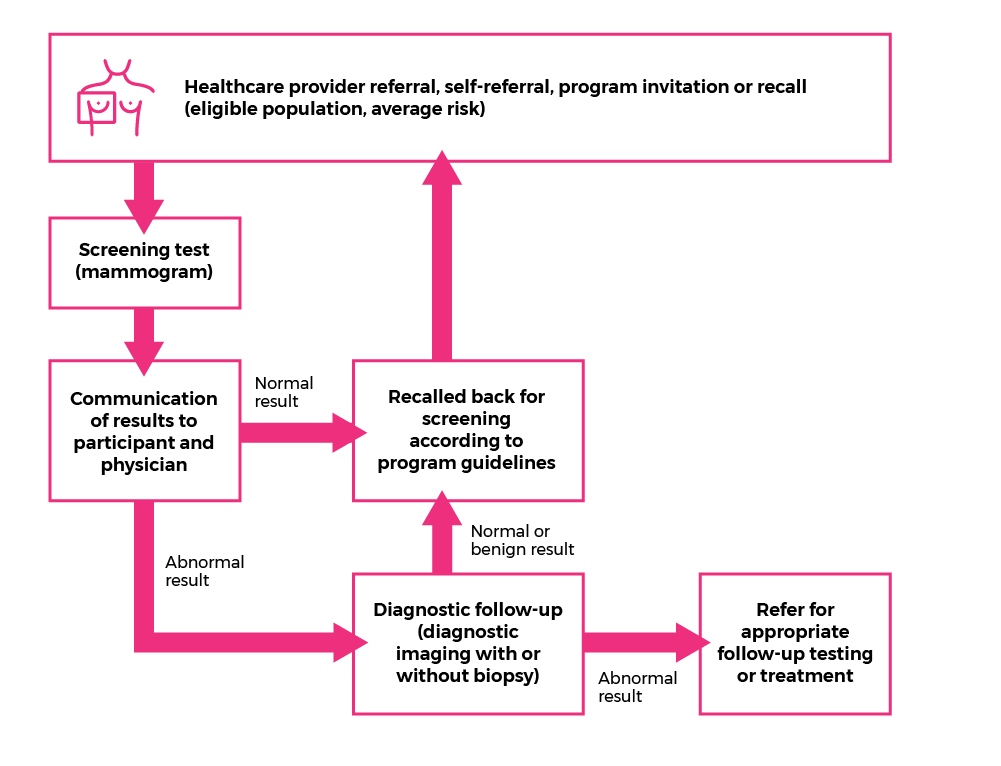
Breast screening pathway
Cancer screening pathways are a general representation of the screening process, and may not apply to all jurisdictions.