
Monitoring and evaluation of colorectal cancer screening quality indicators, 2018-2020

About this resource
This resource aims to share the results of the monitoring of colorectal cancer screening activities across Canada from July 2018 to December 2020. This data can be used to optimize the quality and delivery of colorectal cancer screening programs to reduce colorectal cancer cases and deaths in Canada. The data presented in this resource was collected and validated by jurisdictions.
See colorectal cancer screening indicator data on:
- Participation
- Up-to-date screening
- Follow-up colonoscopy rates
- Wait times
- Invasive cancer detection rates
- Cancer stage distribution (added June 2026)
- Positivity rates (added June 2026)
- Positive predictive values (added June 2026)
- Interval cancer rates (added June 2026)
Key takeaways from this report
- Participation:
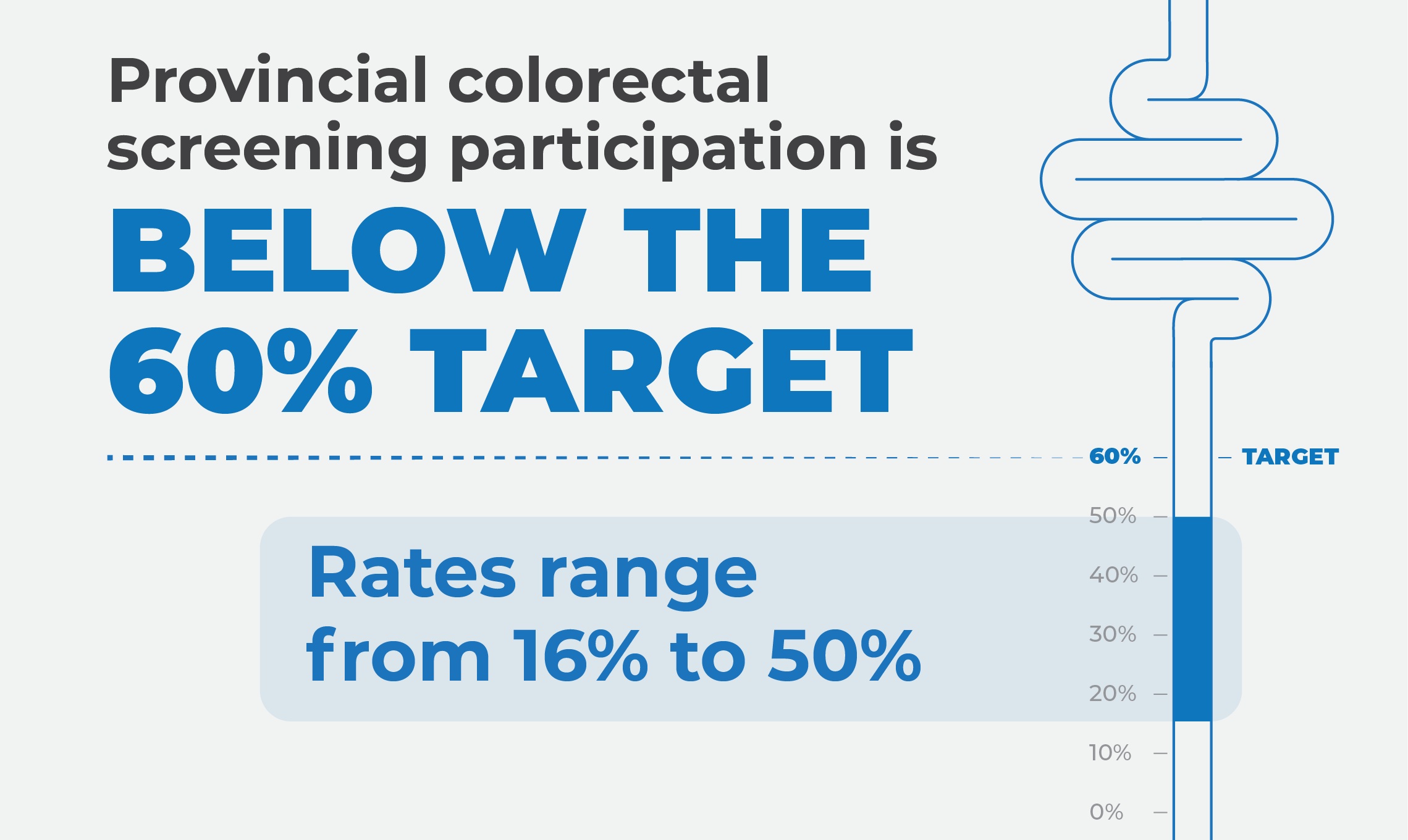
- Jurisdictional participation rates for colorectal cancer screening range from 15.7% to 49.5%, which is below the target of ≥60%. Invitation-based participation rates range from 16% to 52.4%.
- Higher participation rates are seen as age increases and among women of the screen-eligible population.
- Up-to-date screening:
- The percentage of individuals up to date with their colorectal cancer screening ranges from 45.3% to 58.4%.
- Higher rates are seen as age increases and among women.
- Follow-up colonoscopy rates:
- One-third of Canadian provinces are meeting the target of ≥85% of individuals with an abnormal fecal test (FT) result having a follow-up colonoscopy within 180 days. However, there remains variation across provinces with rates ranging from 45.1% to 86.4%.
- Individuals between the ages of 70-74 are least likely to have a follow-up colonoscopy.
- In most cases, follow-up is slightly improved for subsequent fecal tests.
- Wait times:
- Jurisdictional wait times for colonoscopy vary, with 90% of individuals receiving a colonoscopy within 74 to 157 days after referral.
- The percentage of people who complete colonoscopy within 60 days of an abnormal fecal test ranges from 32.4% to 71.5%.
- No jurisdiction is meeting the target for ≥90% of people to have a follow-up colonoscopy within 60 days.
- Invasive cancer detection rates:
- Colorectal cancer detection rates across jurisdictions range from 1.3 to 4.0 per 1,000 individuals screened, with only some jurisdictions meeting the target of ≥2.0 per 1,000.
- Invasive colorectal cancer is more frequently detected among older populations and males.
- Cancer stage distribution:
- Among invasive colorectal cancers detected through programmatic screening, early-stage cancer (I and II) accounts for 51.4% of diagnosed cancers, with jurisdictional proportions ranging from 48.6% to 68.3%.
- Aggregated jurisdictional data shows that subsequent fecal tests detected a slightly larger proportion (52.3%) of early stage (I and II) cancer than first screens (49.2%).
- Positivity rates:
- Positivity rates (the proportion of individuals with an abnormal fecal test result) varied noticeably among provinces, with the lowest rates occurring in provinces that use fecal guaiac tests (FTg) (4.7% to 5.1%) and higher rates among provinces using exclusively fecal immunochemical tests (FTi) (ranging from 6.9% to 14.5%).
- Higher positivity rates are seen among males, and in first versus subsequent screens.
- Positivity rates appear to increase with age.
- Positive predictive values:
- The positive predictive values (PPV) for invasive colorectal cancer (defined as the proportion of individuals with a positive or abnormal fecal test result who are confirmed to have colorectal cancer) ranged from approximately 2.6% to 3.6% across most jurisdictions.
- PPV generally increases with age and is higher at first screening compared with subsequent screening.
- Differences by sex and geographic location were modest and inconsistent.
- Interval cancer rates:
- Interval colorectal cancer rates within 24 months following a normal fecal test result ranged from 0.7 to 0.9 per 1,000 individuals screened.
- Rates increased with age, while the difference by sex was minimal.
- For combined jurisdictions (NB, SK and PE), the post-colonoscopy interval colorectal cancer rate within 6–36 months of a normal colonoscopy was approximately 1.5 per 1,000 individuals aged 50–74.
Colorectal cancer screening resources
- Monitoring and evaluation of colorectal cancer screening quality indicators, 2017-18
- Colorectal cancer screening in Canada, 2026
- Equity-focused interventions to increase colorectal cancer screening
- CanScreen5, International Agency for Research on Cancer, WHO
- Colorectal cancer statistics, Canadian Cancer Society
Next: Key statistics