2025-2026 Annual report
Leadership message
Collaborating with partners across the country, the Canadian Partnership Against Cancer (CPAC) is driving measurable, meaningful change in Canada’s cancer care system. From efforts to eliminate cervical cancer to expanding access to organized screening programs and palliative care, modernizing the cancer data system and delivering culturally appropriate care closer to home, our impact is being felt by people affected by cancer in all provinces and territories.
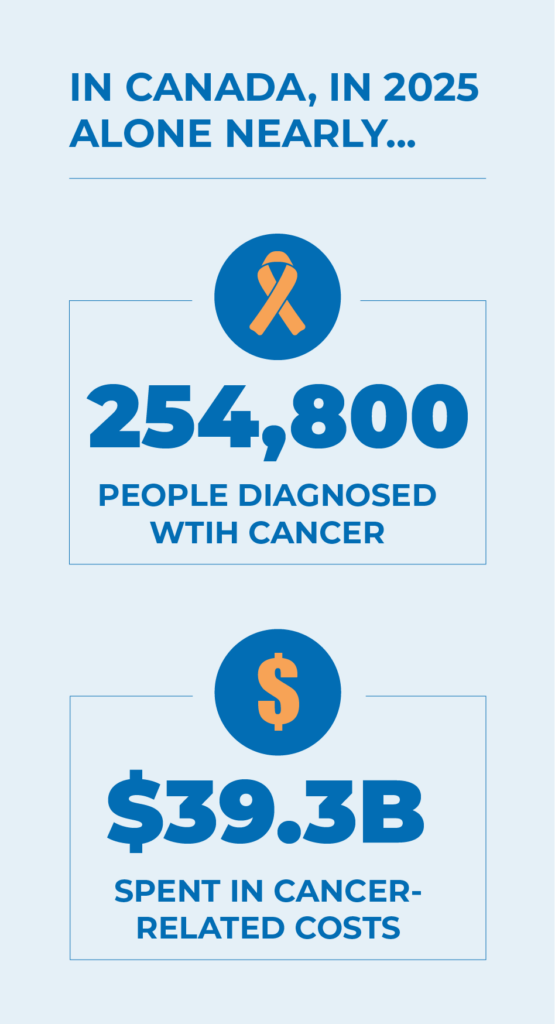
The need for coordinated, system-wide action is more critical than ever. An estimated 42 per cent of people in Canada will face a cancer diagnosis in their lifetime, with nearly 254,800 people diagnosed in 2025 alone. As the burden grows, so does the cost of care. Cancer-related costs reached an estimated $39.3 billion in 2025 and are projected to increase by 24 per cent over the next decade.
As steward of the Canadian Strategy for Cancer Control (the Strategy), CPAC plays an essential role in Canada’s healthcare system. Throughout 2025–2026, we collaborated closely with partners to ensure that public funds delivered the greatest possible impact and advanced high-quality, equitable care for everyone, regardless of who they are or where they live. In this resource-constrained environment, our investments frequently fill critical gaps and catalyze essential programs. The results are clear: coordinated and sustained action by partners since 2006, with support from CPAC, has meant more people in Canada have access to high-quality cancer prevention, screening and care, helping to avert an estimated 218,000 cancer cases, 28,500 cancer deaths and $30.2 billion in cancer-related healthcare treatment costs over the past decade.
The impact of CPAC’s work this year spans the cancer care continuum:
- Prevention and early intervention: Canada is within reach of eliminating cervical cancer by 2040, but urgent action is required to meet that goal. The national progress report published by CPAC in January 2026 showed that with urgent and immediate action to increase HPV vaccination coverage rates and switch to HPV primary screening, Canada could achieve cervical cancer elimination as early as 2031, preventing more than 6,800 cervical cancer cases and saving 1,750 lives in the following decade. Across the country, with the support of CPAC, jurisdictions are advancing toward this goal, from Prince Edward Island achieving 80 per cent HPV vaccination coverage to the Northwest Territories establishing organized cervical screening for the first time.
- Earlier, more equitable diagnosis: CPAC-supported lung screening in four provinces increased participation by 214 per cent, with more than 8,000 people screened and earlier detection rising significantly. At the same time, integrating smoking cessation into care pathways has expanded culturally safer supports for First Nations, Inuit and Métis peoples, now available in 66 per cent of outpatient cancer centres.
- Transforming care for lasting change: Health systems are redesigning care to better meet patient needs. In Newfoundland and Labrador, expanding community chemotherapy sites from 13 to 45 has reduced the travel burden experienced by cancer patients and carers by bringing care closer to home. Nationally, collaborative efforts have expanded access to palliative care for more than 9,000 patients and caregivers facing barriers such as homelessness or vulnerable housing, while other initiatives are also embedding consistent approaches to fertility preservation and post-treatment care.
- Advancing reconciliation: CPAC continues to strengthen relationships with First Nations, Inuit and Métis partners to advance culturally appropriate cancer care. More than 750 communities and organizations are benefiting from over 60 supported projects across all jurisdictions, reflecting a sustained commitment to partnership, trust and meaningful system change.
- The data behind better cancer care: Investments in cancer data are enabling more timely, informed decision-making. Through $14 million in funding across 34 projects, the pan-Canadian Cancer Data Strategy is being implemented nationwide. Artificial intelligence (AI) is improving the timeliness of cancer registry processing, reducing manual workload by thousands of hours annually. AI models are being shared across jurisdictions while respecting privacy legislation, producing cross-jurisdictional efficiencies and expanding data science capacity. Expanded sociodemographic data collection in Manitoba and Prince Edward Island is also helping identify and address disparities in care.
- Embedding equity while improving system sustainability: Equity-focused design delivers both better outcomes and more efficient use of resources. In Alberta, a new cancer diagnosis pathway for people experiencing homelessness integrates supports such as housing, food access and mental health services. This approach has reduced unnecessary genitourinary (urinary and reproductive system) cancer testing, improving care for a high-need population, saving approximately $176,000 per month and creating a model for scalable savings in other jurisdictions.
We invite you to learn about these initiatives in our 2025–2026 annual report.
As we look ahead to 2026–2027, we are laying the foundation for our next five-year plan. With the Strategy as our guide, we will continue to focus on areas where CPAC can drive the greatest impact while advancing a more innovative, high-quality cancer care system that is grounded in equity and reconciliation.
Together with our partners, we remain confident in achieving a Canada where fewer people develop cancer, more people survive, and those affected live well.